Age gaps in rela- tionships are not as bad as you think
On screen and in real life, they are getting smaller anyway
IT WAS NOT love at first sight. When Nick Viall,a reality-television star,met his wife Natalie Joy,he insisted they would never date.His reluctance stemmed in part from being 18 years older, about the length of a generation.Mr Viall married Ms Joy in 2024. Now he is embarking on a different sort of courtship:trying to seduce new viewers."Age of Attraction",a dating series hosted by Mr Viall and Ms Joy, will debut on Netflix later this year. The show follows single 22- to 59-year-olds to test whether "age is just a number". Mr Viall has said the programme will set aside cultural biases about age to focus on compatibility.It is a romantic idea that speaks to an empirical truth. Age gaps are not as unhealthy as some assume.
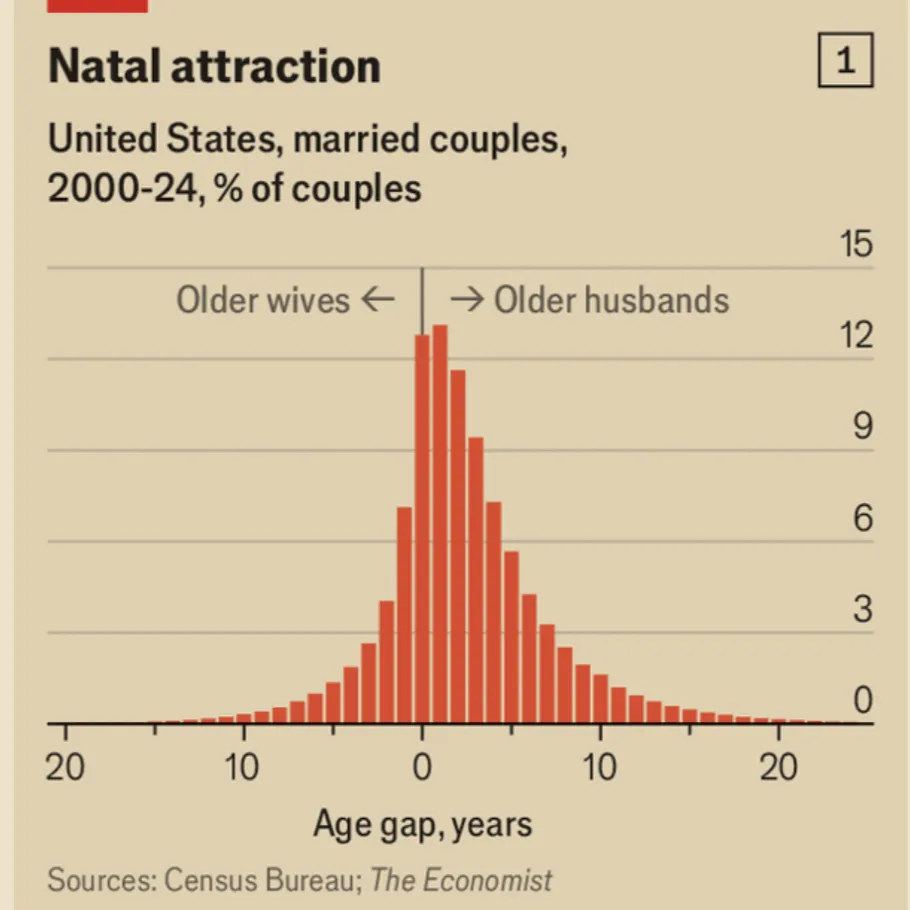
Birds of a feather flock together, as the say- ing goes, and so do people. Researchers studying marriage data have found that couples tend to be similar in age. This is not entirely unexpected.People frequently pair up with others who share similar traits, including race,education and religion.In America one in eight married couples is the same age,to the nearest year; a third is no more than a year younger or older (see chart 1).Schooling reinforces this trend by sorting pupils into age-based cohorts,oth- erwise known as classes.
And yet, though both men and women tend to choose partners close to their own age, the most common pairing-two-thirds of American marriages-is between an older man and a younger woman.This pattern can be found in almost every country across the world. A recent paper by researchers at the Pew Research Centre, a think-tank, puts the global average gap at 4.2 years.In North America husbands are 2.2 years older than their wives, on average; in Europe the average age gap is 2.7 years; in Asia-Pacific it is 4. The age difference is highest in sub-Saharan Africa:8.6 years.
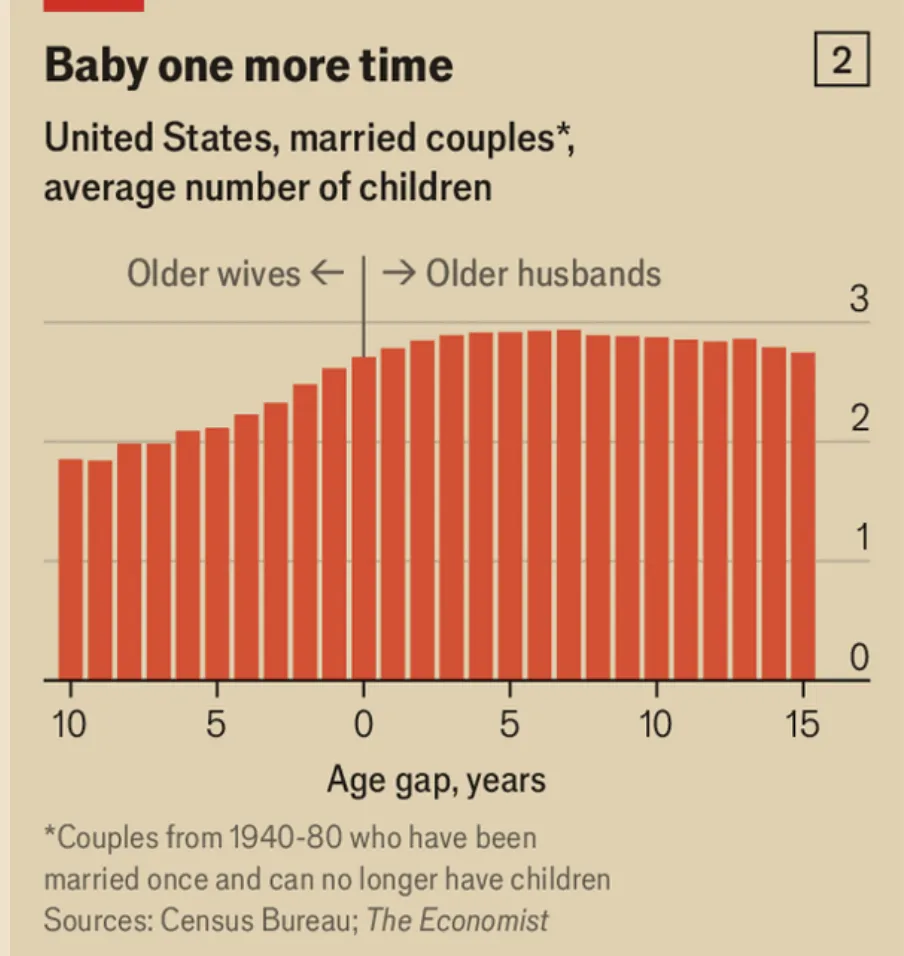
Why are age gaps so common? The leading explanation is evolutionary. Men, it is argued, prefer partners who are fertile; women prefer mates who can provide for their offspring. Since women are most fer- tile when they are young, and men tend to accumulate resources with age, a modest gap should, in theory, produce more chil- dren. Data show this to be true. A paper published in 2007 by researchers at the Uni- versity of Vienna showed that Swedish cou- ples in which the husband is roughly five years older than the wife have 5% more chil- dren than same-age couples. American data tell a similar story (see chart 2).The benefit of an older, wealthier husband may be even greater in poor countries.
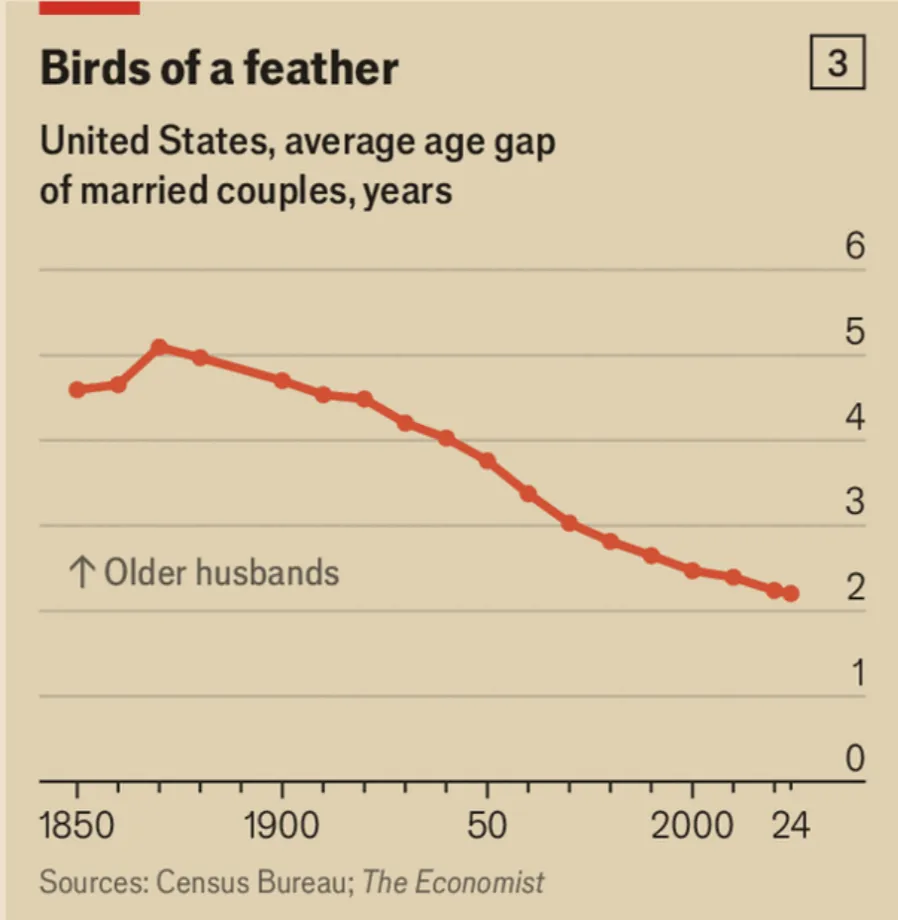
Social norms play a part,too. Those attracted to a much older or younger part- ner may choose someone closer to their own age to avoid raising eyebrows."Can you bring someone who's 20 years younger to your parents?" asks Renata Topinkova, a social scientist at Ludwig Maximilian Uni- versity of Munich. What is considered acceptable changes over time.In 1920 American husbands were about 4.5 years older than their wives, compared with 2.2 years today (see chart 3). Once-common"trophy wives"-young spouses of high-earning men-are now rare enough in Amer- ica that they can no longer be spotted in the data (though they can still be spotted at country clubs like Mar-a-Lago).
Even the age gaps on screen are narrower today than in the past, when Clark Gable(38) starred opposite Vivien Leigh (26) in"Gone With the Wind" and Humphrey Bog- art (43) alongside Ingrid Bergman (27) in"Casablanca".Today romantic partners in films and on Tv are typically around six years apart, down from nearly 20 in the1940s-50s. When films do show dramatic age gaps, they are often subverting tradi- tion, by instead showing an older woman with a younger man.This includes "Baby- girl" (female boss with an intern),"The Idea of You"(4o-year-old with a boy-band star) and "Marty Supreme" (ageing actress with a young table-tennis pro).These do not reflect common situations. But that is rarely Hollywood's intent.
Are relationships between people of differ- ent ages less healthy?The conventional wisdom is that partners born decades apart may not share the same interests and values(not to mention pop-culture references). Power imbalances may emerge,too,partic- ularly when the older partner earns more. Surveys show that people often disapprove of age gaps because they believe the younger partner may be looking for a parental figure or-worse?-a fortune.("I ain't saying she's a gold digger," Kanye West sang in a popular song, saying exactly that.) Couples with age differences of at least ten years report suffering more social disap- proval.Ms Joy has said online critics have branded her a "child bride" and other "terri- ble,terrible things".
However, the evidence suggests that such relationships are relatively happy and last just as long.A study published in 2002 by researchers at Maastricht University found that marriages with larger age gaps are associated with higher life satisfaction for both spouses. Researchers at Britain's Office for National Statistics also found no strong link between age differences and divorce among couples in England and Wales.American evidence points the same way. Data from the Centers for Disease Control and Prevention show that couples with larger age gaps last even longer than those with smaller ones. Using a sample of nearly 5,o00 long-term, live-in relationships, The Economist estimates that a five-year dif- ference in age is associated with staying together an extra six weeks.
Age gaps do bring some risks,however. The incidence of intimate-partner homicide rises sharply when the man is at least 16 years older than the woman (or the woman at least ten years older than the man). But such cases are rare. For most relationships other factors are more important:"Whether it's a ten-year gap, or a two-year gap, your relationship is going to be driven by other things" than age difference, says Paul East- wick, a professor at the University of Cali- fornia, Davis. Like, say, what show to watch on Netflix. Mr Viall and Ms Joy can certainly agree on that.