外刊精读(20260518)——男性恋爱方式与女性有何不同,新研究给你带来新答案
- 2026-07-26 13:21:26

男性恋爱方式与女性有何不同:两项研究带来的新答案
引言
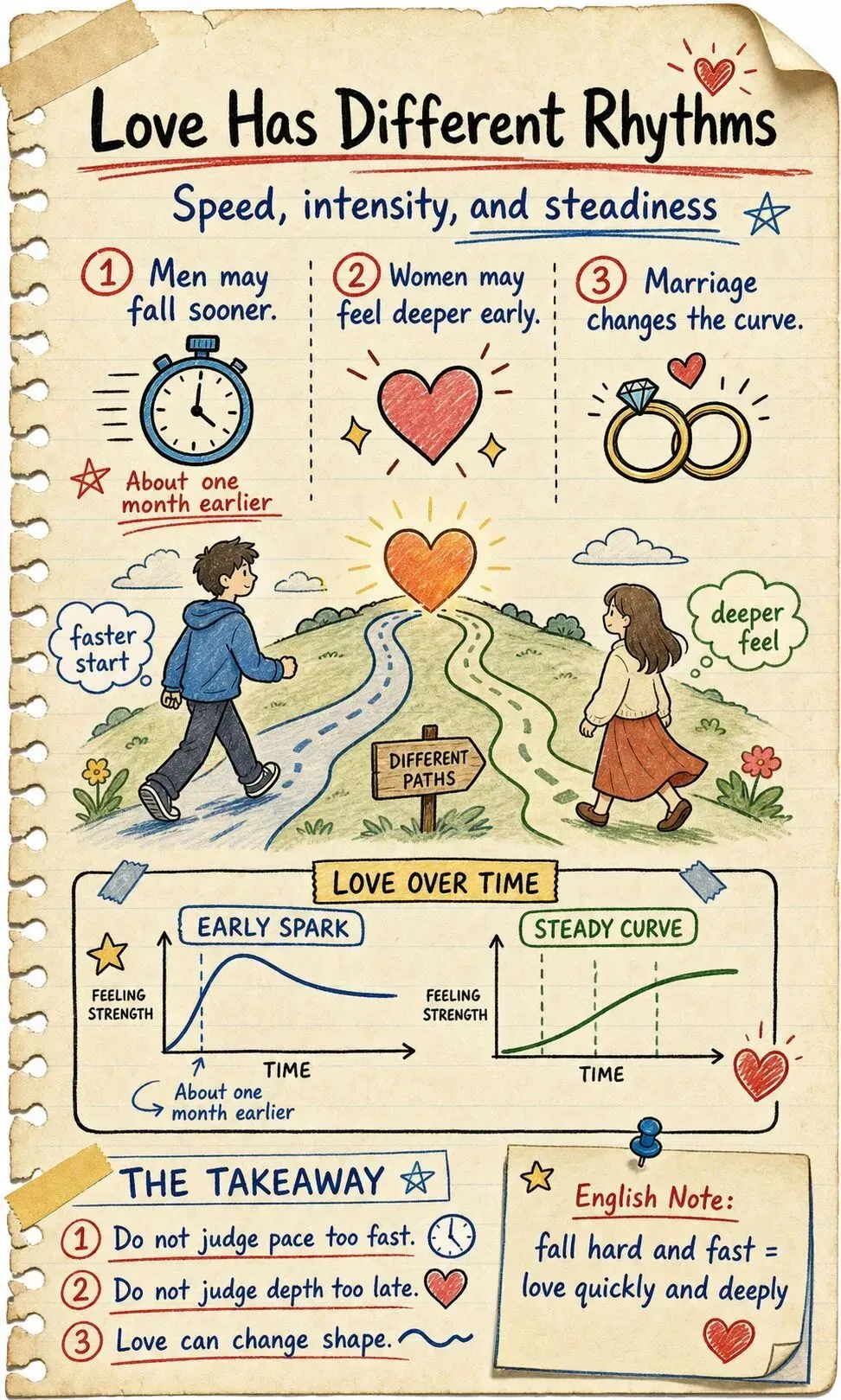
我们常听到一种流行说法:女性更浪漫、更深情,男性更克制、更迟钝,也更容易抽身离开。但这篇文章借助两项近年的同行评议研究,提出了一个更细致、也更温和的观点:男女在恋爱中的差异并不是“谁更会爱”,而是“爱的速度、强度和变化曲线不同”。
概要
核心观点:男性并不一定更慢热,女性也不只是“更浪漫”
文章围绕两项研究展开:一项关注年轻人在“正在恋爱”时的体验,另一项用手机日记追踪成年人在订婚、婚姻早期等阶段的真实情绪。两项研究共同推翻了一个旧刻板印象:男性并非天然情感迟钝,女性的浪漫体验也并非在所有维度上都更强。
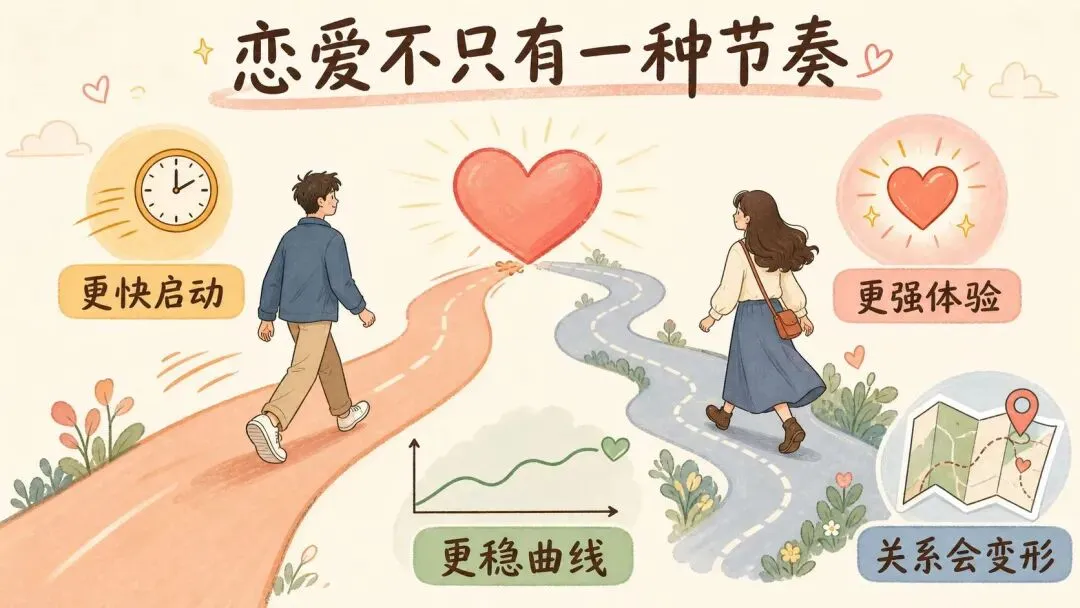
第一项差异:男性更快坠入爱河,女性体验更强烈
2025 年发表于 Biology of Sex Differences 的研究调查了 33 个国家中 808 名 18 至 25 岁、正在经历浪漫爱情的年轻人。
研究发现,男性平均比女性早约一个月坠入爱河。这并不意味着男性更轻率,也不必然等同于“爱情轰炸”。作者转述研究者的解释:从进化角度看,男性更早、更频繁地进入爱情状态,可能有助于在求偶中更快展示承诺。
女性则在另一个维度上更突出:她们的爱情体验略强烈,也更容易反复思考所爱之人。换句话说,女性不一定更早到达“我爱你”的节点,但一旦进入爱情,情感强度和认知投入可能更高。
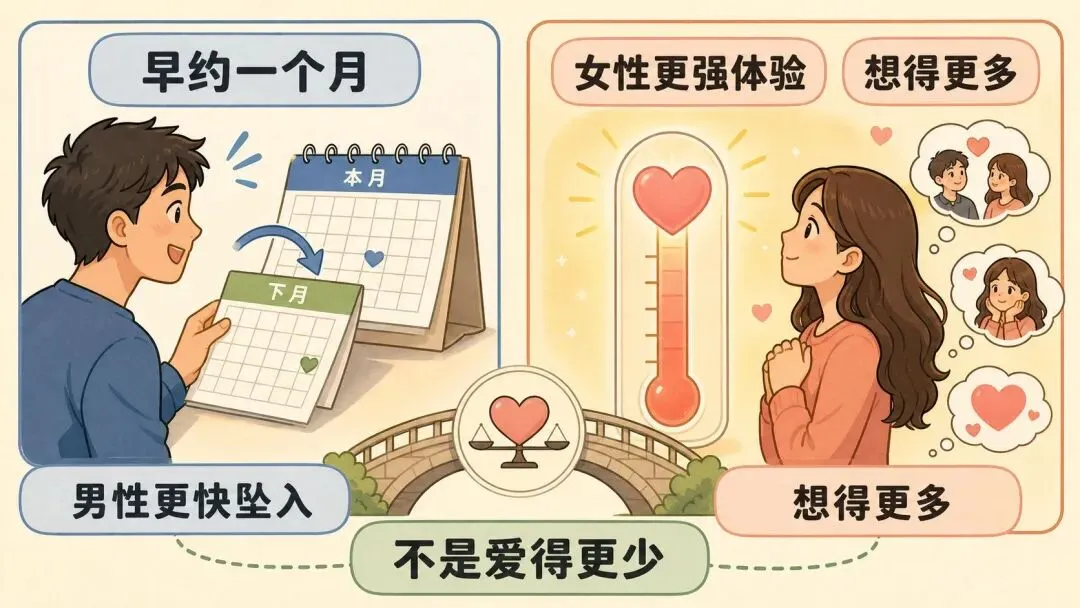
第二项差异:女性在婚姻早期有更高峰值,男性曲线更平稳
2024 年发表于 Psychological Science 的纵向研究追踪了 3,867 名美国成年人。他们每 30 分钟通过手机日记报告一次情绪,这一过程在一年多内重复了四轮。
在异性恋关系中,女性在订婚阶段与伴侣相处时,更可能报告强烈的爱意,比例超过男性的两倍。但进入婚后头两年后,女性报告的伴侣之爱明显下降,男女水平趋于接近。相比之下,男性的爱意下降更温和。
这并不是说女性婚后“不爱了”。文章强调,研究也承认男女总体爱的体验存在广泛相似性。真正值得注意的是:女性的曲线更像“高峰后转入现实生活”,男性的曲线则更稳定、更缓慢。
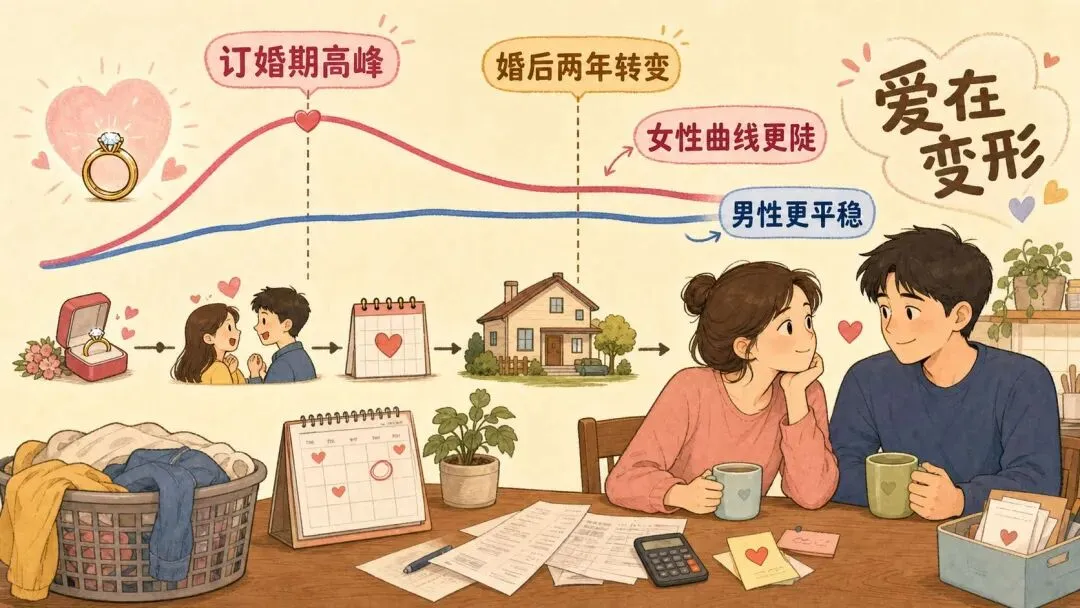
关系中的实际启发:不要把节奏差异误读为爱得不够
这篇文章最有价值的地方,并不是简单地给男女贴上新标签,而是提醒读者:两个人可能以不同速度、不同强度、不同情绪曲线走向同一种亲密连接。
- 男性先说“我爱你”: 可能是真实地更早抵达情感节点,不一定是表演或冲动。
- 女性更晚确认关系: 可能是更谨慎地评估,但进入爱情后体验更深、更密集。
- 婚后激情变化: 不必马上解释为感情失败,也可能是关系从求偶阶段进入生活阶段后的自然变形。
- 关系经营重点: 理解对方的爱的节奏,比要求对方按自己的节奏表达爱更重要。
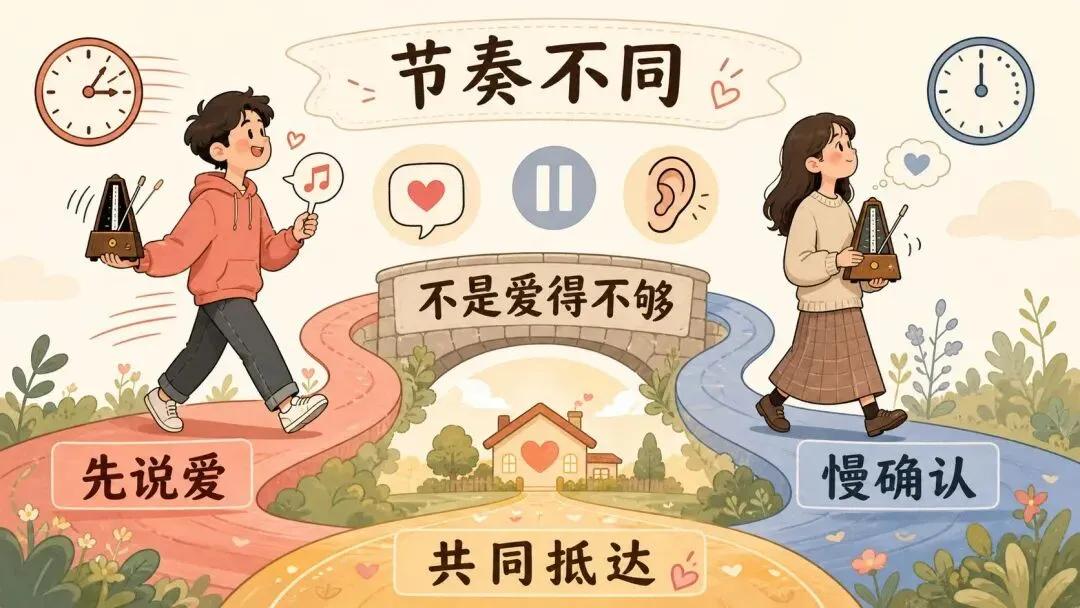
结论
文章最终拆解了两个相反的神话:男性并非总是慢热和疏离,女性也并非在每个维度上都更浪漫。更准确的图景是:男性可能更快进入爱情,并在长期关系中更平稳;女性可能更强烈地体验早期爱情,也更敏感地感受关系阶段变化。爱情不是一条统一赛道,而是两个人用不同节奏共同抵达亲密。
英文原文
Research reveals two primary ways men [[Diverge from|diverge from]] women when falling in love.
When it comes to love, women are often purported to be the romantics: they feel deeply, invest early, and sustain the emotional heartbeat of a relationship.
Men, by contrast, are presented as more stoic and less infatuated.
They’re guarded, slower to open up, and, by extension, even quicker to check out.
This is a story that we’ve all heard countless times, yet according to a growing body of peer-reviewed research, it’s largely wrong.
Two recent peer-reviewed studies have finally offered us a more accurate and more hopeful picture of how men experience romantic love.
Beyond just challenging hegemonic stereotypes, these findings also offer us a much clearer map of how men and women fall in love differently.
Here’s a breakdown of the differences the studies found, as well as what those differences mean in practice for a romantic relationship.
Men Fall in Love Faster, But Women Feel It More Intensely
In a landmark 2025 study published in Biology of Sex Differences, researchers surveyed 808 young adults aged 18 to 25 who were actively experiencing romantic love — including participants of varying sexual orientations from across 33 different countries.
This was the first study of its kind to investigate gender differences in romantic love, using validated measures among people currently in love.
This contrasts with most studies, which mostly rely on retrospective recall.
Among other things, one of the most striking discoveries the researchers made was that male participants tended to fall in love about one month earlier than women, on average.
Women, however, were also more likely to experience romantic love slightly more intensely, as well as to think about their loved ones more.
The researchers offered an evolutionary explanation for these findings.
More specifically, they suggest that an increased frequency of falling in love, as well as earlier timing, may have been a means of overcoming the male-specific challenges of courting and demonstrating commitment to women.
This suggests that men evolved to fall hard and fast because, historically, hesitation would have been a competitive disadvantage.
Women, who face various adaptive pressures around mate selection, evolved instead to take more time; however, when they do love, they do so with greater intensity and cognitive preoccupation.
We can surmise from this that a man who says “I love you” first likely isn’t being a reckless or performative love-bomber, as media and popular culture might suggest.
Instead, he might just be wired to arrive there sooner.
On the other hand, a woman who takes longer to reach that declaration—but who thinks about her partner more deeply and feels the emotion more acutely—is simply experiencing love differently, not less.
Understanding this timing gap, as well as resisting the urge to interpret one partner’s pace as a referendum on their feelings, is perhaps one of the most important things a couple can do in their early stages together.
Women’s Love Peaks Early in Marriage, While Men’s Stays Steadier
In a 2024 longitudinal study published in Psychological Science, researchers took an unusually rigorous approach to measuring love as it is actually lived.
Rather than asking people to rate their relationships in surveys, the authors tracked 3,867 U.S. adults who reported their emotions (including love) every 30 minutes for 10 days via a mobile phone diary.
This was repeated four times over more than a year, resulting in one of the richest real-time portraits of experienced love ever assembled.
The key finding was that, in heterosexual relationships, women were more than double as likely as men to report feelings of love when spending time with their partner during their engagement to be married.
However, this was followed by a sharp reduction in women’s feelings of partner love within the first two years of marriage, at which point men and women experienced similar levels.
Contrastingly, men’s reported love declined only modestly.
These findings don’t tell us that women stop loving their partners after marriage.
The study carefully notes the broad similarities between men and women in overall experiences of love.
However, this suggests meaningful gender differences in how romantic emotions evolve over a lifetime.
While women experience a steeper early peak and a more pronounced transition, men sustain a steadier, more gradual curve.
One of the authors’ interpretations is that women are more attuned to the emotional texture of a relationship’s different phases, especially the heightened charge of early commitment and the eventual settling into partnership.
Another notable interpretation is that women often carry a disproportionate share of relational labor within marriage.
For this reason, they may find that the administrative and domestic realities of married life can mute some of the fiery romance that sustained them during courtship, dating, and even engagement phases.
Either way, for couples navigating the transition from engagement to early marriage, this data normalizes that love changes shape over time.
The feeling your partner carries for you today likely looks and feels different from how it did two years ago.
However, this difference in no way suggests that this love has diminished; rather, it has moved through a phase that affects men and women differently.
What Both Studies Tell Us About Men in Love
Taken together, these two pieces of research dismantle two opposing myths simultaneously.
The notion that men are emotionally unavailable and slow to love has been overhauled: men fall in love sooner, more frequently, and with a steadiness that research increasingly suggests is one of the undervalued gifts they bring to long-term relationships.
Similarly, the idea that women are the more romantic sex in every dimension has also been complicated by data showing that while women do love with greater early intensity, their experience of love across marriage follows a more volatile trajectory than men’s.
Instead, the reality of love is that two people can arrive at the same destination through different routes, at different speeds, and with different emotional rhythms.
And in both cases, each is fully capable of the deep, sustained connection that makes a relationship worth building, despite how different their experience of the journey was.
摘要
文章借两项近年研究重新解释男女在恋爱中的差异:男性不一定慢热,女性也不是在所有方面都“更浪漫”。
- 研究一:恋爱启动速度不同: 2025 年研究发现,男性平均比女性早约一个月坠入爱河;女性则更容易体验到略强烈的浪漫爱情,也更常思考所爱之人。
- 研究二:婚姻中的情绪曲线不同: 2024 年纵向研究发现,女性在订婚期伴侣相处时的爱意报告更高,但婚后头两年下降更明显;男性的下降更温和。
- 核心解释: 男性的爱情可能更早启动、更平稳延续;女性的爱情可能早期更强烈,也更敏感地随关系阶段变化。
- 关系启发: 不要把“表达得早或晚”“热烈或平稳”简单理解为爱得多或少。更成熟的关系,是理解对方爱的节奏。
📝 要点解析
第1句:Research reveals two primary ways men diverge from women when falling in love.
🔸 Translation:研究揭示了男性在坠入爱河时与女性不同的两种主要方式。
🔹 Relatively difficult words and phrases:
- reveal
[rɪˈviːl], _v._ 揭示;显示 ➔ Synonyms: disclose, uncover, show - primary
[ˈpraɪməri], _adj._ 主要的;首要的 ➔ Synonyms: main, chief, principal - [[Diverge from|diverge from]]
[daɪˈvɜːdʒ frəm], _phrase._ 与……不同;分化 ➔ Synonyms: differ from, deviate from
第2句:When it comes to love, women are often purported to be the romantics: they feel deeply, invest early, and sustain the emotional heartbeat of a relationship.
🔸 Translation:谈到爱情,人们常声称女性才是浪漫主义者:她们感受深刻,投入很早,并维系着一段关系的情感心跳。
🔹 Relatively difficult words and phrases:
- when it comes to
[wen ɪt kʌmz tə], _phrase._ 谈到;涉及 ➔ Synonyms: regarding, concerning - [[be purported to be|purported]]
[pəˈpɔːtɪd], _adj._ 据称的;所谓的 ➔ Synonyms: alleged, supposed - sustain
[səˈsteɪn], _v._ 维持;支撑 ➔ Synonyms: maintain, support
第3句:Men, by contrast, are presented as more stoic and less infatuated.
🔸 Translation:相比之下,男性则被描述为更克制,也不那么痴迷。
🔹 Relatively difficult words and phrases:
- by contrast
[baɪ ˈkɒntrɑːst], _phrase._ 相比之下 ➔ Synonyms: conversely, in comparison - [[Stoic|stoic]]
[ˈstəʊɪk], _adj._ 坚忍克制的;不轻易表露情感的 ➔ Synonyms: unemotional, restrained - [[Infatuated|infatuated]]
[ɪnˈfætʃueɪtɪd], _adj._ 迷恋的;痴情的 ➔ Synonyms: besotted, obsessed
第4句:They’re guarded, slower to open up, and, by extension, even quicker to check out.
🔸 Translation:他们被认为更有防备,更慢敞开心扉,并由此被推断为也更快抽身离开。
🔹 Relatively difficult words and phrases:
- [[guarded]]
[ˈɡɑːdɪd], _adj._ 谨慎防备的;不坦露的 ➔ Synonyms: cautious, reserved - open up
[ˈəʊpən ʌp], _phrasal verb._ 敞开心扉;开始坦诚 ➔ Synonyms: confide, disclose - [[by extension]]
[baɪ ɪkˈstenʃn], _phrase._ 引申开来;再则;由此 ➔ Synonyms: consequently, furthermore - check out
[tʃek aʊt], _phrasal verb._ 退出;不再投入 ➔ Synonyms: disengage, withdraw
第5句:This is a story that we’ve all heard countless times, yet according to a growing body of peer-reviewed research, it’s largely wrong.
🔸 Translation:这是我们听过无数次的说法;然而,根据越来越多的同行评议研究,这种说法大体上是错的。
🔹 Relatively difficult words and phrases:
- countless
[ˈkaʊntləs], _adj._ 无数的 ➔ Synonyms: innumerable, numerous - a growing body of
[ə ˈɡrəʊɪŋ ˈbɒdi əv], _phrase._ 越来越多的;不断扩大的 ➔ Synonyms: increasing amount of, expanding range of - peer-reviewed
[ˌpɪə rɪˈvjuːd], _adj._ 经同行评议的 ➔ Synonyms: academically reviewed, scholarly vetted
第6句:Two recent peer-reviewed studies have finally offered us a more accurate and more hopeful picture of how men experience romantic love.
🔸 Translation:最近两项同行评议研究终于为我们提供了一幅更准确、也更有希望的图景,说明男性如何体验浪漫爱情。
🔹 Relatively difficult words and phrases:
- accurate
[ˈækjərət], _adj._ 准确的 ➔ Synonyms: precise, correct - hopeful
[ˈhəʊpfl], _adj._ 充满希望的;乐观的 ➔ Synonyms: optimistic, encouraging - romantic love
[rəʊˈmæntɪk lʌv], _n._ 浪漫爱情 ➔ Synonyms: passionate love, intimate love
第7句:Beyond just challenging hegemonic stereotypes, these findings also offer us a much clearer map of how men and women fall in love differently.
🔸 Translation:这些发现不仅挑战了主导性的刻板印象,也为我们提供了一张更清晰的地图,说明男女坠入爱河的方式有何不同。
🔹 Relatively difficult words and phrases:
- [[Hegemonic|hegemonic]]
[ˌhedʒɪˈmɒnɪk], _adj._ 霸权性的;占主导地位的 ➔ Synonyms: dominant, prevailing - stereotype
[ˈsteriətaɪp], _n._ 刻板印象 ➔ Synonyms: cliché, fixed idea - findings
[ˈfaɪndɪŋz], _n._ 研究发现 ➔ Synonyms: results, conclusions
第8句:Here’s a breakdown of the differences the studies found, as well as what those differences mean in practice for a romantic relationship.
🔸 Translation:下面将分解说明这些研究发现的差异,以及这些差异在一段浪漫关系中的实际意义。
🔹 Relatively difficult words and phrases:
- breakdown
[ˈbreɪkdaʊn], _n._ 分解;细分说明 ➔ Synonyms: analysis, explanation - in practice
[ɪn ˈpræktɪs], _phrase._ 在实践中;实际看来 ➔ Synonyms: practically, in real life - romantic relationship
[rəʊˈmæntɪk rɪˈleɪʃnʃɪp], _n._ 恋爱关系 ➔ Synonyms: intimate relationship, love relationship
第9句:In a landmark 2025 study published in Biology of Sex Differences, researchers surveyed 808 young adults aged 18 to 25 who were actively experiencing romantic love — including participants of varying sexual orientations from across 33 different countries.
🔸 Translation:在一项发表于 Biology of Sex Differences 的 2025 年里程碑式研究中,研究者调查了 808 名 18 至 25 岁、正在经历浪漫爱情的年轻成年人,其中包括来自 33 个不同国家、性取向各异的参与者。
🔹 Relatively difficult words and phrases:
- landmark
[ˈlændmɑːk], _adj._ 里程碑式的;有重大意义的 ➔ Synonyms: groundbreaking, significant - survey
[ˈsɜːveɪ], _v._ 调查;访查 ➔ Synonyms: question, poll - [[Varying Sexual Orientations|varying sexual orientations]]
[ˈveəriɪŋ ˈsekʃuəl ˌɔːriənˈteɪʃnz], _n._ 不同的性取向 ➔ Synonyms: diverse sexual orientations
第10句:This was the first study of its kind to investigate gender differences in romantic love, using validated measures among people currently in love.
🔸 Translation:这是同类研究中第一项使用经过验证的测量工具、针对正在恋爱的人调查浪漫爱情性别差异的研究。
🔹 Relatively difficult words and phrases:
- [[of its Kind|of its kind]]
[əv ɪts kaɪnd], _phrase._ 同类中的 ➔ Synonyms: in its category, of this type - investigate
[ɪnˈvestɪɡeɪt], _v._ 调查;研究 ➔ Synonyms: examine, explore - [[Validated Measures|validated measures]]
[ˈvælɪdeɪtɪd ˈmeʒəz], _n._ 经过验证的测量工具 ➔ Synonyms: tested scales, verified instruments
第11句:This contrasts with most studies, which mostly rely on retrospective recall.
🔸 Translation:这与大多数研究形成对比,因为后者主要依赖回顾性回忆。
🔹 Relatively difficult words and phrases:
- contrast with
[ˈkɒntrɑːst wɪð], _phrase._ 与……形成对比 ➔ Synonyms: differ from, stand against - rely on
[rɪˈlaɪ ɒn], _phrasal verb._ 依赖;依靠 ➔ Synonyms: depend on, rest on - retrospective recall
[ˌretrəˈspektɪv rɪˈkɔːl], _n._ 回顾性回忆 ➔ Synonyms: backward memory, past recall
第12句:Among other things, one of the most striking discoveries the researchers made was that male participants tended to fall in love about one month earlier than women, on average.
🔸 Translation:在众多发现中,研究者最引人注目的发现之一是:男性参与者平均比女性早约一个月坠入爱河。
🔹 Relatively difficult words and phrases:
- among other things
[əˈmʌŋ ˈʌðə θɪŋz], _phrase._ 除其他方面外;其中之一是 ➔ Synonyms: notably, for one thing - striking
[ˈstraɪkɪŋ], _adj._ 引人注目的;显著的 ➔ Synonyms: remarkable, notable - on average
[ɒn ˈævərɪdʒ], _phrase._ 平均而言 ➔ Synonyms: typically, generally
第13句:Women, however, were also more likely to experience romantic love slightly more intensely, as well as to think about their loved ones more.
🔸 Translation:然而,女性也更可能稍微更强烈地体验浪漫爱情,并且更常思念她们所爱的人。
🔹 Relatively difficult words and phrases:
- be likely to
[bi ˈlaɪkli tə], _phrase._ 可能会;倾向于 ➔ Synonyms: tend to, be prone to - intensely
[ɪnˈtensli], _adv._ 强烈地;深切地 ➔ Synonyms: deeply, strongly - loved ones
[lʌvd wʌnz], _n._ 所爱的人;亲近的人 ➔ Synonyms: beloved people, dear ones
第14句:The researchers offered an evolutionary explanation for these findings.
🔸 Translation:研究者为这些发现提供了一种进化论解释。
🔹 Relatively difficult words and phrases:
- evolutionary
[ˌiːvəˈluːʃənəri], _adj._ 进化的;进化论的 ➔ Synonyms: adaptive, biological - explanation
[ˌekspləˈneɪʃn], _n._ 解释;说明 ➔ Synonyms: account, interpretation - finding
[ˈfaɪndɪŋ], _n._ 研究发现 ➔ Synonyms: result, discovery
第15句:More specifically, they suggest that an increased frequency of falling in love, as well as earlier timing, may have been a means of overcoming the male-specific challenges of courting and demonstrating commitment to women.
🔸 Translation:更具体地说,他们认为,男性更频繁地坠入爱河以及更早的恋爱时机,可能曾是一种克服男性特有求偶挑战、向女性展示承诺的方式。
🔹 Relatively difficult words and phrases:
- frequency
[ˈfriːkwənsi], _n._ 频率;发生次数 ➔ Synonyms: rate, regularity - court
[kɔːt], _v._ 求爱;追求 ➔ Synonyms: woo, pursue - demonstrate commitment
[ˈdemənstreɪt kəˈmɪtmənt], _phrase._ 展示承诺 ➔ Synonyms: show devotion, prove dedication
第16句:This suggests that men evolved to fall hard and fast because, historically, hesitation would have been a competitive disadvantage.
🔸 Translation:这表明,男性可能进化出“迅速且强烈坠入爱河”的倾向,因为从历史上看,犹豫会成为竞争劣势。
🔹 Relatively difficult words and phrases:
- fall hard and fast
[fɔːl hɑːd ænd fɑːst], _idiom._ 迅速而强烈地陷入爱情 ➔ Synonyms: fall deeply, become quickly attached - hesitation
[ˌhezɪˈteɪʃn], _n._ 犹豫;迟疑 ➔ Synonyms: reluctance, uncertainty - competitive disadvantage
[kəmˈpetətɪv ˌdɪsədˈvɑːntɪdʒ], _n._ 竞争劣势 ➔ Synonyms: drawback, handicap
第17句:Women, who face various adaptive pressures around mate selection, evolved instead to take more time; however, when they do love, they do so with greater intensity and cognitive preoccupation.
🔸 Translation:女性在择偶方面面临各种适应性压力,因此进化出花更多时间的倾向;然而,当她们真正去爱时,她们会以更高强度和更多认知投入去爱。
🔹 Relatively difficult words and phrases:
- adaptive pressure
[əˈdæptɪv ˈpreʃə], _n._ 适应性压力 ➔ Synonyms: evolutionary pressure, selective pressure - mate selection
[meɪt sɪˈlekʃn], _n._ 择偶 ➔ Synonyms: partner choice, mate choice - cognitive preoccupation
[ˈkɒɡnətɪv priˌɒkjʊˈpeɪʃn], _n._ 认知上的持续关注;反复惦念 ➔ Synonyms: mental absorption, fixation
第18句:We can surmise from this that a man who says “I love you” first likely isn’t being a reckless or performative love-bomber, as media and popular culture might suggest.
🔸 Translation:由此我们可以推断,一个先说“我爱你”的男人,很可能并不是媒体和大众文化所暗示的那种鲁莽或表演式的“爱情轰炸者”。
🔹 Relatively difficult words and phrases:
- surmise
[səˈmaɪz], _v._ 推测;推断 ➔ Synonyms: infer, deduce - reckless
[ˈrekləs], _adj._ 鲁莽的;不计后果的 ➔ Synonyms: rash, careless - performative
[pəˈfɔːmətɪv], _adj._ 表演性的;做给别人看的 ➔ Synonyms: theatrical, showy
第19句:Instead, he might just be wired to arrive there sooner.
🔸 Translation:相反,他可能只是天生更容易更早抵达那个情感节点。
🔹 Relatively difficult words and phrases:
- be wired to
[bi ˈwaɪəd tə], _phrase._ 天生倾向于;被设定为 ➔ Synonyms: be inclined to, be predisposed to - arrive there
[əˈraɪv ðeə], _phrase._ 到达那个阶段;发展到那一步 ➔ Synonyms: reach that point, get there - sooner
[ˈsuːnə], _adv._ 更早地 ➔ Synonyms: earlier, before long
第20句:On the other hand, a woman who takes longer to reach that declaration—but who thinks about her partner more deeply and feels the emotion more acutely—is simply experiencing love differently, not less.
🔸 Translation:另一方面,一个需要更久才说出这句告白、但更深地思考伴侣并更敏锐地感受情绪的女性,只是在以不同方式体验爱情,而不是爱得更少。
🔹 Relatively difficult words and phrases:
- declaration
[ˌdekləˈreɪʃn], _n._ 宣告;表白 ➔ Synonyms: statement, proclamation - acutely
[əˈkjuːtli], _adv._ 强烈地;敏锐地 ➔ Synonyms: sharply, intensely - not less
[nɒt les], _phrase._ 不是更少;并非程度较低 ➔ Synonyms: not inferior, not weaker
第21句:Understanding this timing gap, as well as resisting the urge to interpret one partner’s pace as a referendum on their feelings, is perhaps one of the most important things a couple can do in their early stages together.
🔸 Translation:理解这种时间差,并克制住把一方的节奏解读为其感情公投结果的冲动,也许是一对伴侣在关系早期最重要的事情之一。
🔹 Relatively difficult words and phrases:
- timing gap
[ˈtaɪmɪŋ ɡæp], _n._ 时间差;节奏差 ➔ Synonyms: time difference, pace gap - resist the urge
[rɪˈzɪst ði ɜːdʒ], _phrase._ 克制冲动 ➔ Synonyms: hold back, refrain from - referendum
[ˌrefəˈrendəm], _n._ 公投;此处指判断标准 ➔ Synonyms: vote, verdict
第22句:In a 2024 longitudinal study published in Psychological Science, researchers took an unusually rigorous approach to measuring love as it is actually lived.
🔸 Translation:在一项发表于 Psychological Science 的 2024 年纵向研究中,研究者采用了一种格外严谨的方法,测量现实生活中被实际体验到的爱。
🔹 Relatively difficult words and phrases:
- longitudinal study
[ˌlɒŋɡɪˈtjuːdɪnl ˈstʌdi], _n._ 纵向研究 ➔ Synonyms: follow-up study, long-term study - rigorous
[ˈrɪɡərəs], _adj._ 严谨的;严格的 ➔ Synonyms: strict, thorough - as it is actually lived
[æz ɪt ɪz ˈæktʃuəli lɪvd], _phrase._ 按照现实生活中的实际样态 ➔ Synonyms: in lived experience, in real life
第23句:Rather than asking people to rate their relationships in surveys, the authors tracked 3,867 U.S. adults who reported their emotions (including love) every 30 minutes for 10 days via a mobile phone diary.
🔸 Translation:作者并没有让人们在问卷中给关系打分,而是追踪了 3,867 名美国成年人,让他们连续 10 天每 30 分钟通过手机日记报告一次情绪,包括爱。
🔹 Relatively difficult words and phrases:
- rather than
[ˈrɑːðə ðæn], _phrase._ 而不是 ➔ Synonyms: instead of, as opposed to - track
[træk], _v._ 跟踪;追踪记录 ➔ Synonyms: monitor, follow - mobile phone diary
[ˈməʊbaɪl fəʊn ˈdaɪəri], _n._ 手机日记 ➔ Synonyms: smartphone diary, digital diary
第24句:This was repeated four times over more than a year, resulting in one of the richest real-time portraits of experienced love ever assembled.
🔸 Translation:这一过程在一年多时间里重复了四次,由此形成了迄今最丰富的实时爱情体验图景之一。
🔹 Relatively difficult words and phrases:
- result in
[rɪˈzʌlt ɪn], _phrasal verb._ 导致;产生 ➔ Synonyms: lead to, produce - real-time portrait
[ˈrɪəl taɪm ˈpɔːtrət], _n._ 实时图景;即时画像 ➔ Synonyms: live picture, immediate profile - assemble
[əˈsembl], _v._ 汇集;组装 ➔ Synonyms: compile, gather
第25句:The key finding was that, in heterosexual relationships, women were more than double as likely as men to report feelings of love when spending time with their partner during their engagement to be married.
🔸 Translation:关键发现是,在异性恋关系中,订婚待婚阶段与伴侣相处时,女性报告爱意的可能性是男性的两倍多。
🔹 Relatively difficult words and phrases:
- heterosexual relationship
[ˌhetərəˈsekʃuəl rɪˈleɪʃnʃɪp], _n._ 异性恋关系 ➔ Synonyms: opposite-sex relationship, straight relationship - more than double
[mɔː ðæn ˈdʌbl], _phrase._ 两倍多 ➔ Synonyms: over twice, more than twice - engagement
[ɪnˈɡeɪdʒmənt], _n._ 订婚;婚约期 ➔ Synonyms: betrothal, pre-marriage period
第26句:However, this was followed by a sharp reduction in women’s feelings of partner love within the first two years of marriage, at which point men and women experienced similar levels.
🔸 Translation:然而,随后在婚后头两年内,女性对伴侣的爱意出现明显下降,到那时男女体验到的水平趋于相似。
🔹 Relatively difficult words and phrases:
- be followed by
[bi ˈfɒləʊd baɪ], _phrase._ 随后是;接着出现 ➔ Synonyms: be succeeded by, lead into - sharp reduction
[ʃɑːp rɪˈdʌkʃn], _n._ 明显下降;急剧减少 ➔ Synonyms: steep decline, marked drop - partner love
[ˈpɑːtnə lʌv], _n._ 对伴侣的爱 ➔ Synonyms: spousal affection, romantic attachment
第27句:Contrastingly, men’s reported love declined only modestly.
🔸 Translation:相比之下,男性报告的爱意只出现了温和下降。
🔹 Relatively difficult words and phrases:
- contrastingly
[kənˈtrɑːstɪŋli], _adv._ 相比之下;形成对照地 ➔ Synonyms: conversely, by contrast - reported love
[rɪˈpɔːtɪd lʌv], _n._ 报告出来的爱意 ➔ Synonyms: self-reported affection, stated love - modestly
[ˈmɒdɪstli], _adv._ 适度地;轻微地 ➔ Synonyms: slightly, moderately
第28句:These findings don’t tell us that women stop loving their partners after marriage.
🔸 Translation:这些发现并不是说女性婚后就不再爱自己的伴侣。
🔹 Relatively difficult words and phrases:
- finding
[ˈfaɪndɪŋ], _n._ 发现;研究结果 ➔ Synonyms: result, conclusion - partner
[ˈpɑːtnə], _n._ 伴侣 ➔ Synonyms: spouse, companion - after marriage
[ˈɑːftə ˈmærɪdʒ], _phrase._ 婚后 ➔ Synonyms: following marriage, once married
第29句:The study carefully notes the broad similarities between men and women in overall experiences of love.
🔸 Translation:该研究也谨慎指出,男女在爱情总体体验上存在广泛相似性。
🔹 Relatively difficult words and phrases:
- carefully note
[ˈkeəfəli nəʊt], _phrase._ 谨慎指出 ➔ Synonyms: cautiously observe, carefully state - broad similarities
[brɔːd ˌsɪməˈlærətiz], _n._ 广泛相似性 ➔ Synonyms: general likenesses, wide commonalities - overall
[ˌəʊvərˈɔːl], _adj._ 总体的;整体的 ➔ Synonyms: general, comprehensive
第30句:However, this suggests meaningful gender differences in how romantic emotions evolve over a lifetime.
🔸 Translation:不过,这确实表明浪漫情绪如何在一生中演变,存在有意义的性别差异。
🔹 Relatively difficult words and phrases:
- meaningful
[ˈmiːnɪŋfl], _adj._ 有意义的;重要的 ➔ Synonyms: significant, important - gender differences
[ˈdʒendə ˈdɪfrənsɪz], _n._ 性别差异 ➔ Synonyms: sex differences, gender gaps - evolve
[ɪˈvɒlv], _v._ 演变;逐渐发展 ➔ Synonyms: develop, change
第31句:While women experience a steeper early peak and a more pronounced transition, men sustain a steadier, more gradual curve.
🔸 Translation:女性经历的是更陡峭的早期高峰和更明显的转变,而男性维持的是更稳定、更渐进的曲线。
🔹 Relatively difficult words and phrases:
- steeper peak
[ˈstiːpə piːk], _n._ 更陡峭的高峰;更明显的峰值 ➔ Synonyms: sharper high point, higher spike - pronounced
[prəˈnaʊnst], _adj._ 明显的;显著的 ➔ Synonyms: obvious, marked - gradual curve
[ˈɡrædʒuəl kɜːv], _n._ 渐进曲线 ➔ Synonyms: slow arc, steady trajectory
第32句:One of the authors’ interpretations is that women are more attuned to the emotional texture of a relationship’s different phases, especially the heightened charge of early commitment and the eventual settling into partnership.
🔸 Translation:作者的一种解释是,女性更能感知关系不同阶段的情感质地,尤其是早期承诺的高涨能量,以及最终安顿进入伴侣关系的变化。
🔹 Relatively difficult words and phrases:
- interpretation
[ɪnˌtɜːprəˈteɪʃn], _n._ 解读;解释 ➔ Synonyms: reading, explanation - attuned to
[əˈtjuːnd tə], _adj._ 对……敏感;能体察 ➔ Synonyms: sensitive to, responsive to - settling into
[ˈsetlɪŋ ˈɪntə], _phrase._ 逐渐安顿进入 ➔ Synonyms: easing into, adapting to
第33句:Another notable interpretation is that women often carry a disproportionate share of relational labor within marriage.
🔸 Translation:另一个值得注意的解释是,女性常常在婚姻中承担不成比例的关系劳动。
🔹 Relatively difficult words and phrases:
- notable
[ˈnəʊtəbl], _adj._ 值得注意的;显著的 ➔ Synonyms: remarkable, noteworthy - disproportionate
[ˌdɪsprəˈpɔːʃənət], _adj._ 不成比例的;过多的 ➔ Synonyms: unequal, excessive - relational labor
[rɪˈleɪʃənl ˈleɪbə], _n._ 关系劳动;维护关系所需的情绪和事务投入 ➔ Synonyms: emotional work, relationship maintenance
第34句:For this reason, they may find that the administrative and domestic realities of married life can mute some of the fiery romance that sustained them during courtship, dating, and even engagement phases.
🔸 Translation:因此,她们可能会发现,婚姻生活中的行政事务和家庭现实,会削弱一些在求爱、约会甚至订婚阶段支撑她们的炽热浪漫。
🔹 Relatively difficult words and phrases:
- administrative and domestic realities
[ədˈmɪnɪstrətɪv ænd dəˈmestɪk riˈælətiz], _n._ 行政事务和家庭现实 ➔ Synonyms: household duties, practical burdens - mute
[mjuːt], _v._ 减弱;使不那么强烈 ➔ Synonyms: soften, dampen - courtship
[ˈkɔːtʃɪp], _n._ 求爱期;追求阶段 ➔ Synonyms: wooing, courting period
第35句:Either way, for couples navigating the transition from engagement to early marriage, this data normalizes that love changes shape over time.
🔸 Translation:无论哪种解释,对正在经历从订婚到婚姻早期转变的伴侣来说,这些数据让“爱会随时间改变形态”这件事变得正常。
🔹 Relatively difficult words and phrases:
- either way
[ˈaɪðə weɪ], _phrase._ 无论哪种情况 ➔ Synonyms: in any case, regardless - navigate the transition
[ˈnævɪɡeɪt ðə trænˈzɪʃn], _phrase._ 应对转变;走过过渡期 ➔ Synonyms: manage the shift, move through change - normalize
[ˈnɔːməlaɪz], _v._ 使正常化;让人认为正常 ➔ Synonyms: make acceptable, destigmatize
第36句:The feeling your partner carries for you today likely looks and feels different from how it did two years ago.
🔸 Translation:你的伴侣今天对你怀有的感情,很可能看起来、感觉起来都与两年前不同。
🔹 Relatively difficult words and phrases:
- carry for
[ˈkæri fɔː], _phrase._ 对……怀有(感情) ➔ Synonyms: hold for, feel for - likely
[ˈlaɪkli], _adv._ 很可能 ➔ Synonyms: probably, presumably - look and feel different
[lʊk ænd fiːl ˈdɪfrənt], _phrase._ 看起来和感觉起来不同 ➔ Synonyms: seem different, feel changed
第37句:However, this difference in no way suggests that this love has diminished; rather, it has moved through a phase that affects men and women differently.
🔸 Translation:然而,这种差异绝不意味着爱已经减少;相反,它只是经历了一个会以不同方式影响男女的阶段。
🔹 Relatively difficult words and phrases:
- in no way
[ɪn nəʊ weɪ], _phrase._ 绝不;完全不 ➔ Synonyms: by no means, not at all - diminish
[dɪˈmɪnɪʃ], _v._ 减少;减弱 ➔ Synonyms: lessen, decrease - move through a phase
[muːv θruː ə feɪz], _phrase._ 经历一个阶段 ➔ Synonyms: pass through a stage, go through a period
第38句:Taken together, these two pieces of research dismantle two opposing myths simultaneously.
🔸 Translation:合在一起看,这两项研究同时拆解了两个相反的神话。
🔹 Relatively difficult words and phrases:
- taken together
[ˈteɪkən təˈɡeðə], _phrase._ 合在一起看 ➔ Synonyms: considered jointly, viewed together - dismantle
[dɪsˈmæntl], _v._ 拆解;推翻 ➔ Synonyms: deconstruct, overturn - simultaneously
[ˌsɪmlˈteɪniəsli], _adv._ 同时地 ➔ Synonyms: at the same time, concurrently
第39句:The notion that men are emotionally unavailable and slow to love has been overhauled: men fall in love sooner, more frequently, and with a steadiness that research increasingly suggests is one of the undervalued gifts they bring to long-term relationships.
🔸 Translation:“男性情感上不可及且爱得慢”这一观念已经被改写:男性更早、更频繁地坠入爱河,并带着一种稳定性,而研究越来越表明,这种稳定性是他们带入长期关系的一种被低估的礼物。
🔹 Relatively difficult words and phrases:
- emotionally unavailable
[ɪˈməʊʃənəli ˌʌnəˈveɪləbl], _adj._ 情感上不可及的;难以投入情感的 ➔ Synonyms: detached, closed-off - overhaul
[ˈəʊvəhɔːl], _v._ 彻底改写;大修 ➔ Synonyms: revise, transform - undervalued
[ˌʌndəˈvæljuːd], _adj._ 被低估的 ➔ Synonyms: underappreciated, underestimated
第40句:Similarly, the idea that women are the more romantic sex in every dimension has also been complicated by data showing that while women do love with greater early intensity, their experience of love across marriage follows a more volatile trajectory than men’s.
🔸 Translation:同样,“女性在每个维度上都是更浪漫的一方”这一想法,也被数据复杂化了:数据显示,女性确实以更高的早期强度去爱,但她们在婚姻中的爱情体验轨迹比男性更波动。
🔹 Relatively difficult words and phrases:
- in every dimension
[ɪn ˈevri daɪˈmenʃn], _phrase._ 在每个维度上 ➔ Synonyms: in every respect, across all aspects - volatile trajectory
[ˈvɒlətaɪl trəˈdʒektəri], _n._ 波动较大的轨迹 ➔ Synonyms: unstable path, fluctuating arc - complicate
[ˈkɒmplɪkeɪt], _v._ 使复杂化 ➔ Synonyms: nuance, qualify
第41句:Instead, the reality of love is that two people can arrive at the same destination through different routes, at different speeds, and with different emotional rhythms.
🔸 Translation:相反,爱情的现实是:两个人可以沿着不同路线、以不同速度、带着不同情感节奏,到达同一个目的地。
🔹 Relatively difficult words and phrases:
- destination
[ˌdestɪˈneɪʃn], _n._ 目的地;目标 ➔ Synonyms: endpoint, goal - route
[ruːt], _n._ 路线;路径 ➔ Synonyms: path, way - emotional rhythm
[ɪˈməʊʃənl ˈrɪðəm], _n._ 情感节奏 ➔ Synonyms: affective pace, emotional tempo
第42句:And in both cases, each is fully capable of the deep, sustained connection that makes a relationship worth building, despite how different their experience of the journey was.
🔸 Translation:而在两种情况下,无论他们对这段旅程的体验有多么不同,双方都完全有能力建立深刻而持久的连接,使一段关系值得被经营。
🔹 Relatively difficult words and phrases:
- fully capable of
[ˈfʊli ˈkeɪpəbl əv], _phrase._ 完全有能力 ➔ Synonyms: well able to, competent to - sustained connection
[səˈsteɪnd kəˈnekʃn], _n._ 持久连接 ➔ Synonyms: lasting bond, enduring attachment - worth building
[wɜːθ ˈbɪldɪŋ], _phrase._ 值得建立;值得经营 ➔ Synonyms: worth developing, worth nurturing
无障碍阅读
Research reveals (揭示) two primary (主要的) ways men diverge from (与……不同) women when falling in love.
When it comes to love, women are often purported (据称的) to be the romantics: they feel deeply, invest early, and sustain (维系) the emotional heartbeat of a relationship. Men, by contrast (相比之下), are presented as more stoic (克制的) and less infatuated (痴迷的). They’re guarded (有防备的), slower to open up (敞开心扉), and, by extension, even quicker to check out (抽身离开). This is a story that we’ve all heard countless times, yet according to a growing body of peer-reviewed (同行评议的) research, it’s largely wrong.
Two recent peer-reviewed studies have finally offered us a more accurate and more hopeful picture of how men experience romantic love. Beyond just challenging hegemonic stereotypes (主导性刻板印象), these findings also offer us a much clearer map of how men and women fall in love differently.
Here’s a breakdown (分解说明) of the differences the studies found, as well as what those differences mean in practice (在实践中) for a romantic relationship.
In a landmark (里程碑式的) 2025 study published in Biology of Sex Differences, researchers surveyed 808 young adults aged 18 to 25 who were actively experiencing romantic love — including participants of varying sexual orientations (性取向) from across 33 different countries.
This was the first study of its kind to investigate gender differences in romantic love, using validated measures (经过验证的测量工具) among people currently in love. This contrasts with (与……形成对比) most studies, which mostly rely on retrospective recall (回顾性回忆). Among other things, one of the most striking (显著的) discoveries the researchers made was that male participants tended to fall in love about one month earlier than women, on average (平均而言). Women, however, were also more likely to experience romantic love slightly more intensely (强烈地), as well as to think about their loved ones more.
The researchers offered an evolutionary (进化论的) explanation for these findings. More specifically, they suggest that an increased frequency (频率) of falling in love, as well as earlier timing, may have been a means of overcoming the male-specific challenges of courting (求爱) and demonstrating commitment (展示承诺) to women. This suggests that men evolved to fall hard and fast (迅速而强烈地陷入爱情) because, historically, hesitation (犹豫) would have been a competitive disadvantage (竞争劣势). Women, who face various adaptive pressures (适应性压力) around mate selection (择偶), evolved instead to take more time; however, when they do love, they do so with greater intensity and cognitive preoccupation (持续惦念).
We can surmise (推断) from this that a man who says “I love you” first likely isn’t being a reckless (鲁莽的) or performative (表演性的) love-bomber, as media and popular culture might suggest. Instead, he might just be wired to (天生倾向于) arrive there sooner. On the other hand, a woman who takes longer to reach that declaration (告白)—but who thinks about her partner more deeply and feels the emotion more acutely (敏锐地;强烈地)—is simply experiencing love differently, not less.
Understanding this timing gap (时间差), as well as resisting the urge (克制冲动) to interpret one partner’s pace as a referendum (判断标准) on their feelings, is perhaps one of the most important things a couple can do in their early stages together.
In a 2024 longitudinal study (纵向研究) published in Psychological Science, researchers took an unusually rigorous (严谨的) approach to measuring love as it is actually lived (在现实生活中的实际样态). Rather than asking people to rate their relationships in surveys, the authors tracked (追踪) 3,867 U.S. adults who reported their emotions (including love) every 30 minutes for 10 days via a mobile phone diary (手机日记). This was repeated four times over more than a year, resulting in one of the richest real-time portraits (实时图景) of experienced love ever assembled.
The key finding was that, in heterosexual relationships (异性恋关系), women were more than double (两倍多) as likely as men to report feelings of love when spending time with their partner during their engagement (订婚期) to be married. However, this was followed by a sharp reduction (明显下降) in women’s feelings of partner love within the first two years of marriage, at which point men and women experienced similar levels. Contrastingly (相比之下), men’s reported love declined only modestly (轻微地).
These findings don’t tell us that women stop loving their partners after marriage. The study carefully notes the broad similarities (广泛相似性) between men and women in overall experiences of love. However, this suggests meaningful gender differences (有意义的性别差异) in how romantic emotions evolve (演变) over a lifetime. While women experience a steeper early peak (更陡峭的早期高峰) and a more pronounced transition (更明显的转变), men sustain a steadier, more gradual curve.
One of the authors’ interpretations (解释) is that women are more attuned to (敏感于) the emotional texture of a relationship’s different phases, especially the heightened charge of early commitment and the eventual settling into (逐渐安顿进入) partnership. Another notable interpretation is that women often carry a disproportionate (不成比例的) share of relational labor (关系劳动) within marriage. For this reason, they may find that the administrative and domestic realities (行政事务和家庭现实) of married life can mute (减弱) some of the fiery romance that sustained them during courtship (求爱期), dating, and even engagement phases.
Either way, for couples navigating the transition (应对转变) from engagement to early marriage, this data normalizes (使正常化) that love changes shape over time. The feeling your partner carries for you today likely looks and feels different from how it did two years ago. However, this difference in no way (绝不) suggests that this love has diminished (减少); rather, it has moved through a phase that affects men and women differently.
Taken together, these two pieces of research dismantle (拆解;推翻) two opposing myths simultaneously (同时地). The notion that men are emotionally unavailable (情感上不可及的) and slow to love has been overhauled (彻底改写): men fall in love sooner, more frequently, and with a steadiness that research increasingly suggests is one of the undervalued (被低估的) gifts they bring to long-term relationships.
Similarly, the idea that women are the more romantic sex in every dimension (在每个维度上) has also been complicated by data showing that while women do love with greater early intensity, their experience of love across marriage follows a more volatile trajectory (波动较大的轨迹) than men’s. Instead, the reality of love is that two people can arrive at the same destination (目的地) through different routes (路线), at different speeds, and with different emotional rhythms (情感节奏). And in both cases, each is fully capable of the deep, sustained connection (持久连接) that makes a relationship worth building (值得经营), despite how different their experience of the journey was.
原文来源:Psychology Today
翻译:AI + 人工润色
图片:AI + Canva
声明:原文为转载,不代表本公众号观点


We are all in the gutter, but some of us are looking at the stars.
我们都生活在阴沟里,但仍有人仰望星空。
长按识别二维码,与你相伴而行……
或许你还想看
外刊精读(20260517)——焦虑让我睡不着,怎样才能入睡?



